


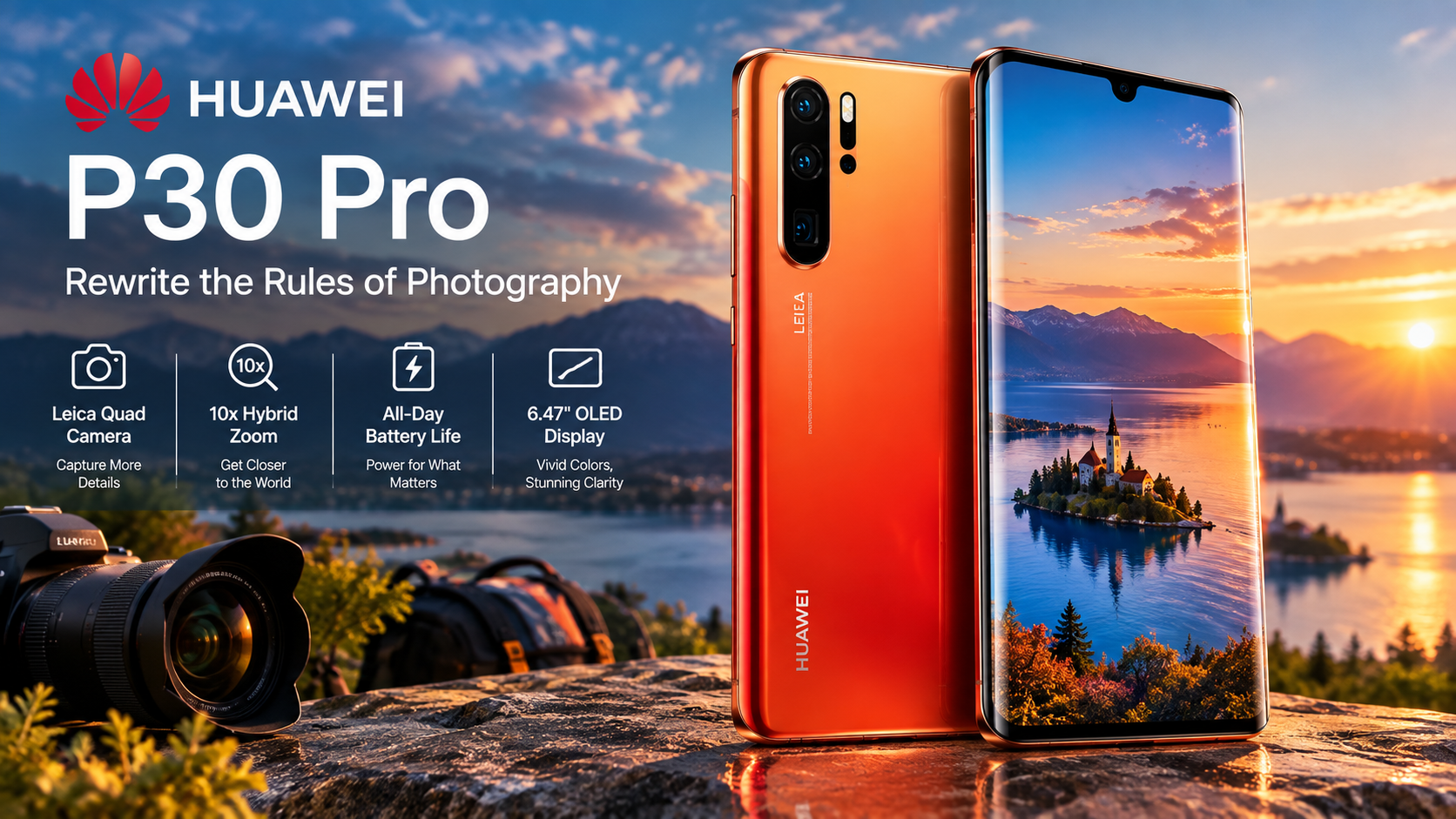
The Huawei P30 Pro remains one of the most memorable flagship smartphones from Huawei. Released in 2019, the device attracted significant attention because of its advanced camera system, premium design, large OLED display, and strong battery capacity. At a time when smartphone photography was becoming one of the most important features for consumers, Huawei positioned the P30 Pro as a device designed for people who wanted greater flexibility from a phone camera.
Although newer smartphones now offer more advanced processors, displays, and software features, the Huawei P30 Pro is still an interesting device to examine because several of its ideas became important trends in the smartphone industry. Its combination of optical zoom, low-light photography, battery life, and premium construction helped establish a strong reputation for the P-series.
Huawei P30 Pro Design and Build Quality
The Huawei P30 Pro features a premium glass-and-metal construction that gives the phone a sophisticated flagship appearance. Its curved edges and rounded frame make the large device more comfortable to hold than its dimensions might initially suggest. The back panel has a glossy finish, while the front uses curved edges around the display to create a modern appearance.
Huawei also offered the phone in several attractive finishes, including Aurora, Breathing Crystal, Black, Amber Sunrise, Pearl White, and other regional color options. The different finishes helped the device stand out from many competing smartphones that traditionally used simpler black, white, or silver designs.
Another important feature was its IP68 rating for dust and water resistance. This provided additional protection against accidental exposure to water and dust, although water resistance should not be considered permanent because seals can deteriorate with age and physical wear.
Huawei P30 Pro Display
The Huawei P30 Pro comes with a 6.47-inch OLED display featuring curved edges. It has a Full HD+ resolution of 2340 × 1080 pixels and a 19.5:9 aspect ratio. The OLED technology provides deep blacks, strong contrast, and vibrant colors, making the screen suitable for watching videos, browsing photographs, reading, and everyday applications.
The curved design was also part of Huawei’s flagship styling strategy. Instead of using a completely flat panel, the display extends slightly toward the sides of the phone. This creates a distinctive visual appearance and helps reduce the perceived width of the device.
For everyday use, the display remains one of the strengths of the Huawei P30 Pro. However, compared with modern premium smartphones, its 60Hz refresh rate is an important difference. Many newer devices now offer 90Hz, 120Hz, or even higher refresh rates, which can provide smoother scrolling and animations.
Huawei P30 Pro Camera System
The camera system is arguably the most important reason the Huawei P30 Pro became famous. Huawei developed a Leica-branded quad-camera setup that provided several focal lengths and photography options.
The primary camera uses a 40MP sensor with an f/1.6 aperture and optical image stabilization. It is accompanied by a 20MP ultra-wide camera, an 8MP telephoto camera, and a Time-of-Flight sensor for depth information.
The telephoto camera was particularly significant because it provided 5x optical zoom. Huawei also promoted 10x hybrid zoom, while digital zoom could extend considerably further under suitable conditions.
This zoom system gave the phone an advantage for photographing distant subjects. Users could capture details from buildings, landscapes, signs, performances, and other scenes without physically moving closer to the subject.
Low Light Photography
Low-light photography was another major strength of the Huawei P30 Pro. The primary sensor used a distinctive RYYB color-filter arrangement rather than the more conventional RGGB arrangement commonly found in smartphone cameras.
Huawei designed this system to capture more light, and the results helped the P30 Pro become widely recognized for nighttime photography. The phone could produce usable images in situations where many smartphone cameras of the same generation struggled.
Night photography also benefited from Huawei’s computational photography algorithms. Multiple frames could be combined to improve exposure, reduce noise, and preserve details. This approach became increasingly common throughout the smartphone industry.
Huawei P30 Pro Performance
The Huawei P30 Pro is powered by the Kirin 980 chipset, which was manufactured using a 7nm process. The processor was designed to deliver flagship-level performance for its generation while also improving power efficiency.
The Kirin 980 uses an octa-core CPU configuration with two high-performance Cortex-A76 cores, two additional Cortex-A76 cores focused on efficiency, and four Cortex-A55 efficiency cores. Graphics processing is handled by the Mali-G76 MP10 GPU.
For normal tasks such as web browsing, messaging, social media, video streaming, photography, and multitasking, the hardware was powerful for its release period. It could also handle demanding games, although modern software requirements mean performance expectations should be considered differently today.
Battery Life and Charging
Battery life was another area where the Huawei P30 Pro performed strongly. It contains a 4,200mAh battery, which was a substantial capacity for a flagship smartphone released in 2019.
Huawei supported 40W wired SuperCharge technology, allowing the phone to recharge significantly faster than many competing devices of its generation. The phone also supported 15W wireless charging and reverse wireless charging.
Reverse wireless charging was an interesting feature because it allowed the P30 Pro to share some of its battery power with compatible accessories or smartphones. This demonstrated Huawei’s effort to make the device more than just a conventional handset.
Storage and Memory Options
Huawei released the P30 Pro in different memory and storage configurations depending on the market. Common configurations included 6GB or 8GB of RAM, with internal storage options including 128GB, 256GB, and 512GB.
The phone also supported Huawei’s NM memory card format for expandable storage. This differs from the microSD cards commonly used by many Android smartphones.
For users who take many high-resolution photographs and videos, additional storage can be useful. However, compatibility with Huawei’s proprietary NM format is something buyers should consider when purchasing or maintaining the device today.
Software Experience
The Huawei P30 Pro originally launched with Android 9 and Huawei’s EMUI software. Huawei subsequently provided software updates for the device during its supported period.
One major distinction is that the P30 Pro belongs to the generation of Huawei phones that originally shipped with Google Mobile Services. This means the international version launched with access to Google applications and services such as Google Maps, Gmail, Google Drive, and the Google Play Store.
This is important when comparing the P30 Pro with later Huawei smartphones because Huawei’s relationship with Google changed after U.S. restrictions were introduced in 2019.
Huawei P30 Pro Key Specifications
| Feature | Huawei P30 Pro |
|---|---|
| Display | 6.47-inch OLED |
| Resolution | 2340 × 1080 pixels |
| Processor | Kirin 980 |
| RAM | 6GB / 8GB |
| Storage | 128GB / 256GB / 512GB |
| Main Camera | 40MP |
| Ultra-Wide Camera | 20MP |
| Telephoto Camera | 8MP |
| Depth Sensor | ToF |
| Front Camera | 32MP |
| Battery | 4,200mAh |
| Wired Charging | 40W |
| Wireless Charging | 15W |
| Operating System at Launch | Android 9 with EMUI |
| Water Resistance | IP68 |
Connectivity and Everyday Features
The Huawei P30 Pro supports 4G LTE connectivity along with Wi-Fi, Bluetooth, NFC, GPS, and other standard connectivity technologies available on flagship smartphones of its generation.
The phone also introduced an interesting approach to audio. Instead of relying entirely on a traditional earpiece speaker, Huawei used acoustic display technology for voice calls. Sound could be transmitted through vibrations in the display area.
The device also includes an in-display fingerprint sensor. This allowed users to unlock the smartphone without placing a fingerprint reader on the front or rear of the phone.
How the Huawei P30 Pro Changed Smartphone Photography
The influence of the Huawei P30 Pro extends beyond its own specifications. Its camera system demonstrated how smartphones could combine multiple lenses, computational photography, and advanced sensors to provide different photographic perspectives.
The 5x optical zoom was particularly important because it showed that smartphone cameras did not have to depend entirely on digital enlargement. A dedicated telephoto lens could provide a genuinely different shooting capability.
The phone’s low-light performance also contributed to a broader shift toward computational photography. Manufacturers increasingly began focusing not only on sensor size and megapixels but also on software processing, multi-frame imaging, artificial intelligence, and specialized camera hardware.
Huawei P30 Pro Compared With Modern Smartphones
A modern smartphone can outperform the Huawei P30 Pro in several technical areas. Newer processors are considerably faster and more efficient, while modern displays often provide higher refresh rates and improved brightness.
Modern flagship cameras can also offer larger sensors, improved stabilization, faster image processing, and advanced computational photography. Battery technology and charging systems have also progressed considerably.
However, comparing the P30 Pro only by specifications misses its historical importance. When it launched, its camera flexibility and zoom capabilities were highly competitive and helped influence what consumers expected from premium smartphone cameras.
Is the Huawei P30 Pro Still Relevant?
The answer depends largely on what a buyer expects from a smartphone. The P30 Pro can still be interesting for photography enthusiasts, collectors, and people looking for an older flagship device with a strong camera system.
However, anyone considering the phone today should check its battery condition, software support, physical condition, network compatibility, and availability of replacement parts. An older smartphone may have experienced battery degradation after several years of use.
Software compatibility is another important consideration. Some modern applications may require newer Android versions or security features, so buyers should not expect the same long-term software experience available from current smartphones.
Final Thoughts
The Huawei P30 Pro holds an important place in smartphone history because it brought together several technologies that were becoming increasingly important to premium mobile devices. Its 40MP main camera, 5x optical zoom, ultra-wide camera, low-light capabilities, OLED display, large battery, and fast charging made it a highly capable flagship when it launched.
Its biggest contribution was arguably its approach to mobile photography. Rather than treating the camera as a single sensor, Huawei created a multi-camera system designed for different shooting situations. This helped demonstrate how optical zoom, specialized sensors, and computational photography could work together in a smartphone.
While newer devices now offer substantially more advanced hardware and software, the Huawei P30 Pro remains a noteworthy example of how smartphone photography evolved. For anyone interested in the development of modern flagship phones, its camera technology and overall design make it a device worth remembering. Read more
FAQs
1. What is the Huawei P30 Pro known for?
The Huawei P30 Pro is best known for its versatile Leica camera system, 5x optical zoom, strong low-light photography, premium OLED display, and large 4,200mAh battery.
2. What processor does the Huawei P30 Pro use?
The Huawei P30 Pro is powered by Huawei’s Kirin 980 octa-core processor, which was a flagship chipset when the phone launched in 2019.
3. How good is the Huawei P30 Pro camera?
The phone features a 40MP main camera, 20MP ultra-wide camera, 8MP telephoto camera, and a ToF depth sensor. Its optical zoom and low-light photography were among its major strengths.
4. Does the Huawei P30 Pro support fast charging?
Yes. The Huawei P30 Pro supports 40W wired SuperCharge, along with 15W wireless charging and reverse wireless charging.
5. What is the battery capacity of the Huawei P30 Pro?
The phone has a 4,200mAh battery, which provided strong battery endurance for its generation.
6. Did the Huawei P30 Pro come with Google services?
Yes. International versions of the Huawei P30 Pro launched with Google Mobile Services and the Google Play Store.
7. Does the Huawei P30 Pro have water resistance?
Yes. The Huawei P30 Pro has an IP68 rating for dust and water resistance.
